Certificado de ensayo EN 10204 3.1: cómo leerlo antes de aceptar la entrega
El certificado 3.1 lo emite el fabricante, no un tercero. Esta es la revisión línea por línea que recomendamos antes de liberar el pago de un pedido de tubería de acero inoxidable.
Por Dakai Steel Technical Team
EN 10204 3.1 is the document most stainless steel pipe buyers ask for, and the one most often read only at the last minute. This guide lists what the certificate actually certifies, which fields to cross-check against the purchase order, and where a 3.1 stops short.
What a 3.1 certificate certifies
EN 10204:2004 defines the types of inspection documents used when metallic products are delivered. Type 3.1 is an inspection certificate issued by the manufacturer's authorised inspection representative — a function that is independent of the production department. The certificate declares that the delivered material conforms to the order and records the specific inspection and test results for that delivery.
The key phrase is manufacturer-issued. A 3.1 is the mill's own document. It is not countersigned by a third-party inspection body; that is what type 3.2 adds.
The four fields to check first
1. Standard and grade
The certificate must name the product standard and grade exactly as ordered — for example ASTM A312 TP316L or EN 10216-5 1.4404. A 304 certificate does not cover a 316L order, and a document that lists only a generic standard without the grade is not sufficient. If the contract names a standard edition or year, check that the certificate cites the same one.
2. Heat number and traceability
Every pipe in the delivery should be traceable to a heat number printed on the certificate, and that number should be stamped, stencilled or labelled on the pipes or their bundles. If the heat number on the certificate cannot be matched to the physical material, the certificate proves nothing about the material you received.
3. Chemical composition
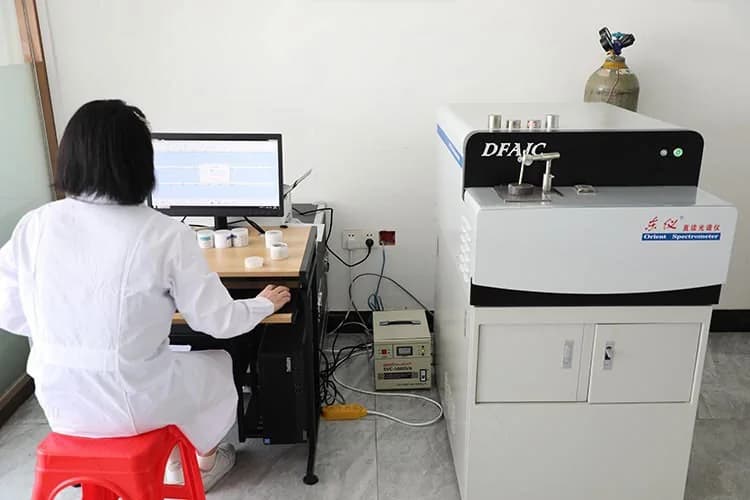
Compare each element against the grade limits, not only against the certificate's own verdict. A 316L certificate should show carbon at 0.030% maximum, and the molybdenum range matters for corrosion resistance. Check whether the values are cast analysis or product analysis; the applicable standard defines the permitted deviations between the two.
4. Mechanical properties
Tensile strength, yield strength and elongation are reported as test results. Check the test standard used, the specimen orientation where relevant, and the test temperature. If the purchase order requires impact testing at a stated temperature, the energy values must appear on the certificate — a room-temperature test does not satisfy a low-temperature requirement.
3.1 versus 3.2 in one sentence
A 3.2 certificate carries the same inspection results, but is also countersigned by an independent inspection organisation appointed by the purchaser or by a third party. If the contract says 3.2, a 3.1 certificate is a non-conforming document even when the numbers look identical.
What a 3.1 certificate does not prove
It does not prove that a third party witnessed the tests. It does not confirm that the material was produced at the mill named in the letterhead rather than converted elsewhere, unless the purchase order and the certificate's scope make that explicit. And it does not replace a positive material identification (PMI) check or a dimensional inspection on arrival.
For a 316L order, the certificate is normally read together with the 316L stainless steel seamless pipe specification, so that the grade limits and the delivered dimensions are checked against the same source.
A pre-payment checklist
- Standard, grade and edition match the purchase order.
- Heat number on the certificate matches the marking on the pipes.
- Chemical composition sits inside the grade limits; deviations are explained by the standard.
- Tensile, yield and elongation are within the required range, with the test standards named.
- Any additional requirement — impact test, NDT, corrosion test, surface finish — appears with results.
- The document is signed and stamped by the manufacturer's authorised inspection representative, with a date.
If any of these lines is missing or ambiguous, ask for a corrected certificate or a written clarification before the balance payment. A certificate that cannot be checked line by line is a document, not a quality record.