Food Plant Audits: The 7 Documents a Pipe Supplier Must Hand Over
BRCGS, IFS and FSSC 22000 audits grade documents, not metallurgy. The seven a food plant's QA actually opens, and the three that get sent back.
By Dakai Steel Technical Team
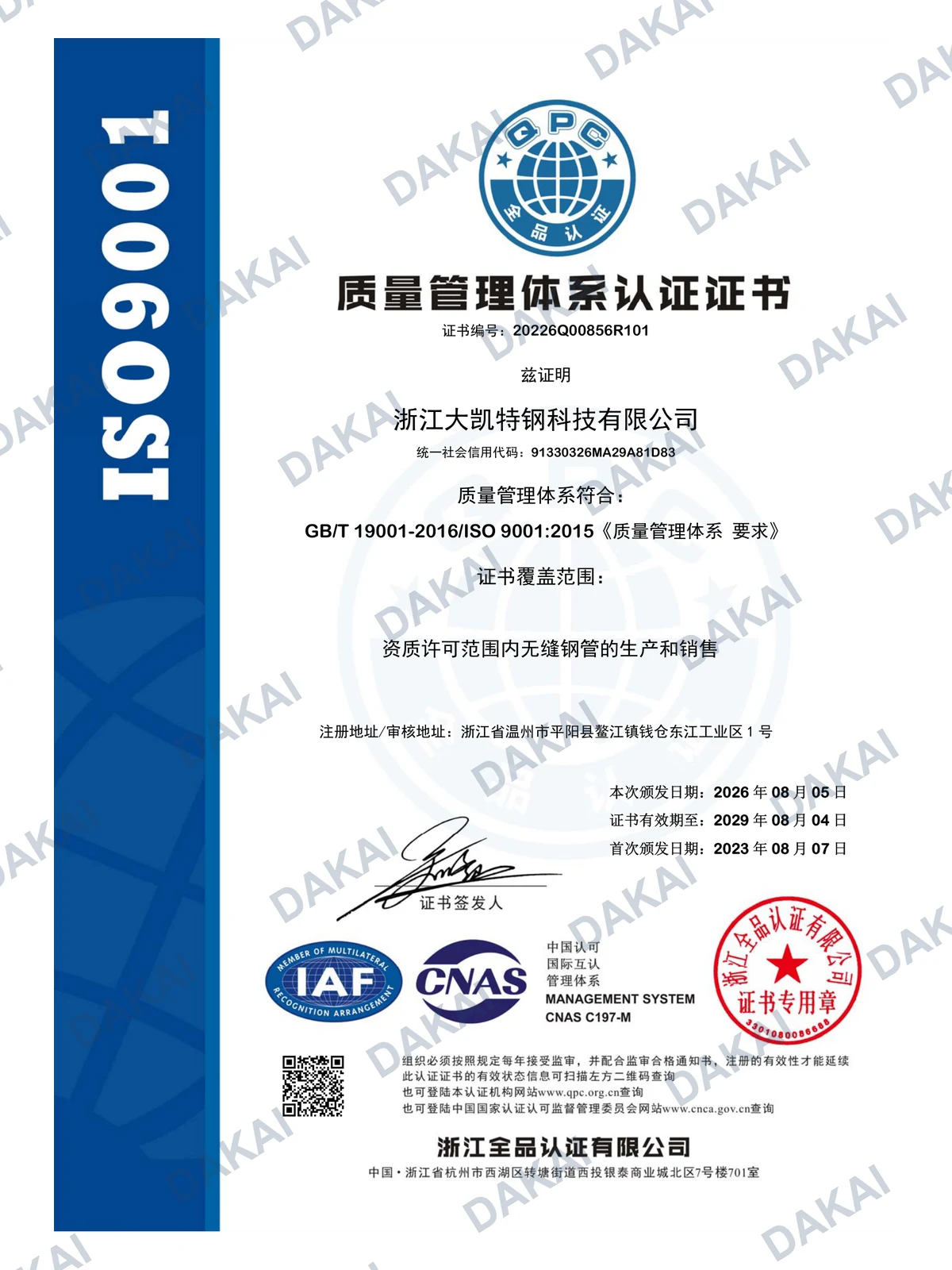
A food plant audit — BRCGS, IFS, FSSC 22000, or a customer's own supplier visit — does not grade the metallurgy of your tube. It grades whether you can be listed as an approved supplier, and the evidence is almost entirely paperwork. The same sanitary tube is a food-contact material with a complete file, and a length of stainless steel without one. Below are the seven documents a food plant's QA team actually opens, in the order they ask for them, and where each one gets sent back.
Seven questions, seven documents
An auditor does not ask for everything at once. The questions come in sequence: what is this material, may it touch food, can the bore be cleaned, is the weld sound, was it really passivated, which heat does this lot come from, and will it fit the system. One document answers each question; miss one and the chain stops there.
1. Material certificate: EN 10204 3.1
This answers which heat the tube came from. QA checks three things: the heat number against the stencil or ink-jet mark on the tube; the chemistry in full — C, S, P, Ni, Cr, Mo — because sulphur and phosphorus drive hot cracking in welds; and the standard with its year and grade system, since GB/T 14976, ASTM A269 and ASTM A270 impose different dimensional and surface requirements on the same 316L. Typical rejections: a certificate that says "304" with no grade standard, a 3.1 issued by a trader with no mill inspection stamp or signature, and one heat certificate reused across three sizes.
2. Food-contact declaration of compliance
A DoC is not a quality document; it is a regulatory statement that the material, under its intended use, meets food-contact law. China requires one under GB 4806.1, the EU under Articles 15 and 16 of 1935/2004, and the US has no mandatory DoC but customers ask for the FDA basis — an FCN or a GRAS determination. The most common rejection is one DoC covering every size: QA will ask what a single declaration means for both an 8 mm instrument tube and a 219 mm transfer line. A usable DoC names the grade, the size range, the media and maximum temperature it covers, the clause it relies on, and the report number that supports it.
3. Migration test report
GB 4806.9 sets migration limits for lead, cadmium, arsenic, nickel and chromium from food-contact metal, tested in food simulants at conditions matched to use: 4% acetic acid at 70 °C for 2 hours is the standard case, and frying or hot filling requires stricter conditions. The EU route is 1935/2004 plus the Council of Europe resolution on metals and alloys; the US route is FDA plus California Prop 65. A report is only useful with four things stated: simulant, temperature and time, method (ICP-MS), and the limit source — with a CNAS- or CMA-accredited lab behind it. Rejections cluster on two points: the report tested material rather than the finished tube, and it is more than three years old when the customer wants one within two.
4. Internal roughness report
Cleanability in a food line rests on Ra: dairy, beverage and brewery lines are normally specified at Ra ≤ 0.8 µm, aseptic filling and some dairy at ≤ 0.4 µm. A usable report states instrument model, stylus radius, cut-off (usually 0.8 mm), measurement positions — three or four around the circumference, one crossing the weld — and reports both Ra and Rz. A single Ra number with no test conditions, or a reading taken on the outside diameter, gets returned.
5. Weld and borescope records
The longitudinal weld and the orbital welds made on site are where biofilm settles. The record has to show whether the weld bead was ground flush with the parent metal, whether there is misalignment, whether the bore shows heat tint (poor shielding or incomplete pickling), and whether there are lack-of-fusion defects or pits. Photographs must carry the tube number and date, or they cannot be tied to the goods. This is the item food plants raise most often at handover, because it maps directly onto the 3-A requirement for crevice-free, step-free product contact.
6. Passivation and cleaning records
Passivation follows ASTM A967 or A380; the record should state chemical, concentration, temperature, contact time and neutralisation. Free iron on a stainless surface rusts first, and food plants often verify with a ferroxyl test. Food service adds one item that gets skipped: degreasing. Drawing lubricant or polishing compound left in the bore ends up in the product on the first CIP cycle. Passivation records without a degreasing record still count as incomplete.
7. Lot traceability and packing list
Heat number, tube number, size, quantity, dispatch note and project BOM must form one line, so that any tube traces back to its heat and its inspection records. Food customers are sensitive to silent change: a different heat or a different plant inside the same project, even at the same grade, triggers re-qualification. A supplier who can commit to one heat per project scores on this point alone.
The three details that actually fail
First, documents that do not match the goods: heat number on the certificate, stencil on the tube and label on the bundle must agree, and a single mismatch puts the lot on hold at goods-in for longer than it took to make. Second, declarations that drift from reports: a DoC citing GB 4806.9 attached to a three-year-old mill certificate, or a migration report run on a different grade. Third, a file for the tube but not for the system: fittings, flanges and valves whose certificates do not share the tube's heat and whose connection standards differ — DIN 32676 against ISO 2852 — a mismatch discovered at assembly that the paperwork stage should have caught.
Why the equipment maker needs your file
You sell to the equipment maker, but the file ends up with the food plant's QA. When a pasteuriser, filler or CIP skid is handed over, the documentation package includes the tube certificates, the DoC and the roughness reports; if the end-user audit fails, the equipment maker's acceptance milestone and retention payment stall. Your document set is their bid and handover tool, not a free extra. Turn the seven documents into a reusable template — fixed format, fixed fields, supplied with every lot — and the equipment maker will carry your name into the next tender.
Five clauses to write into the order
One: attach the document list to the contract, with copies, language and stamping specified line by line. Two: add "documents incomplete means not delivered", which puts the cost of chasing paperwork back on the supplier. Three: retain a one-metre sample from each lot, sealed by both sides, for re-testing Ra and chemistry if there is a dispute. Four: change control — a different heat, plant or polish route requires written notice before dispatch. Five: settle six parameters before quoting — medium and concentration, working temperature, CIP chemicals (caustic, nitric, hypochlorite), Ra requirement, connection standard, and destination market, which decides whether the DoC and migration report follow the GB, EU or US route.
China, the EU and the US do not share one file
The same 316L sanitary tube needs a different package in each market. China reads GB 4806.1 and GB 4806.9: a declaration plus heavy-metal migration. The EU reads 1935/2004, the 2023/2006 GMP rules and the Council of Europe metals resolution, and expects a declaration of compliance to travel with the goods. The US has no single positive list for metals in food contact; in practice it relies on an FDA food-contact notification or a GRAS determination, with NSF/ANSI 51 layered on at equipment level. An export project that prepared only the Chinese GB report starts over at the EU customer.
Send the medium, temperature, CIP chemicals and destination market, and we will build the file to your audit list: 3.1 certificate, DoC, migration report, measured Ra, borescope images, passivation and degreasing records, and heat traceability — one set with the goods, a sample length first.